

Journeying with patients
A caregiver’s journey of unwavering love and resilience
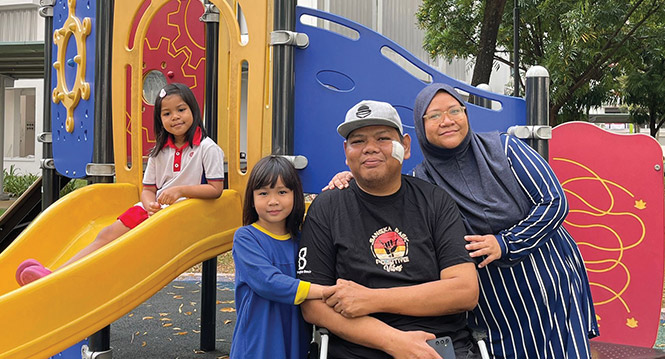
At age 38, Najihah Shahrom cares for her husband Mohammad Najib Lajis, 43, their three children, and her father-in-law. Her story is one of love and resilience in the face of unexpected tribulations.
Najihah met Najib 13 years ago through a mutual friend. Attracted by his easy-going nature, they soon married and had two children, living a comfortable life. However, everything changed when Najib was diagnosed with diabetes while Najihah was pregnant with their third child.
“Every day is a new chance to find strength, cherish the little moments, and remind ourselves that there is always something to be grateful for.”
Najihah Shahrom, a caregiver who is a pillar of strength for her family
Facing unexpected challenges
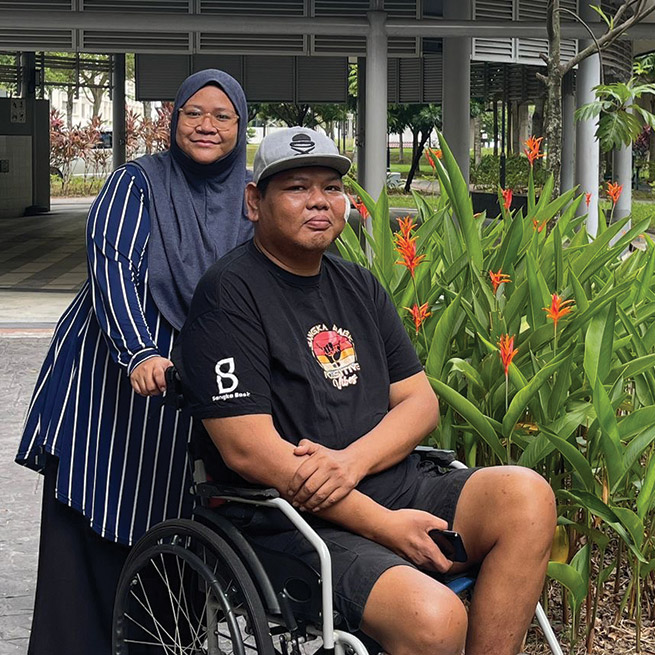
By the time their daughter was one, Najib’s right leg was amputated, and he lost his job, the family’s only source of income. Soon after, he was diagnosed with kidney failure and had to undergo dialysis. The family was thrust into a period of turbulence. Not only did Najihah have to adjust to Covid and the loss of income, she also had to deal with raising three children while caring for her wheelchair-bound husband and her father-in-law, who also suffered from diabetes.
The early months of dialysis were especially hard. Najihah had to wheel Najib to and from the dialysis centre three times a week, often bringing their young children along. Balancing caregiving with her own mental struggles was exceedingly demanding. Despite these challenges, Najihah never gave up. She practiced positive self-talk, reminding herself that better times would come. She focused on gratitude and took each day one step at a time, developing strength and resilience to deal with daily life.
Resourcefulness and adaptability
Najihah’s resourcefulness and responsibility also shone through. Aware that part of her stress came from financial uncertainties, she accessed various governmental and religious support schemes. She also adjusted the family’s lifestyle, cutting costs by no longer eating out regularly and forgoing yearly holidays. Despite these changes, Najihah turned the simplest activities into joyful experiences for her children, from cycling trips around the neighbourhood to visits to St John’s Island.
Support system and coping strategies
Najihah’s journey is not one she takes alone. She relies on family members and friends for support. She attends NKF’s Caregiver Support Group sessions together with Najib to learn coping strategies, often bringing their children along to create a supportive environment for the whole family. Her mother-in-law helps care for Najihah’s father-in-law, and an inner circle of friends provides emotional support. Najib also does his part to lighten her load, taking on household tasks when he can and actively looking for a job to support the family, ensuring they are not solely dependent on social services.
Moving forward with optimism
For Najib and Najihah, love is expressed through their unwavering support for each other. While the family has gotten more used to life with dialysis, challenges remain. Employment is a struggle, and the inability to afford essential items for their children can still be a source of stress. However, the couple remains optimistic. Through the frustrations, struggles, and quarrels that may come up, they will always support each other, forgive each other, and move forward to face the situation head-on.
Najihah exemplifies how a compassionate, loving, and resilient heart can overcome any trial. Her unending positivity, resourcefulness, and dedication to her family are truly inspiring.
Caregiver Support Group
NKF has newly initiated a Caregiver Support Group for those caring for kidney failure patients undergoing dialysis.
This initiative provides crucial emotional support, offering a safe space for caregivers to share their feelings and experiences openly. It facilitates the exchange of valuable caregiving techniques, helping to reduce stress and prevent burnout through peer support and stress management strategies.
Additionally, the group promotes social connections to combat isolation, equipping caregivers with essential skills, resources, and confidence to better care for their loved ones and themselves. Since its inception, over 130 caregivers have benefitted from this initiative.


