

Life saving care
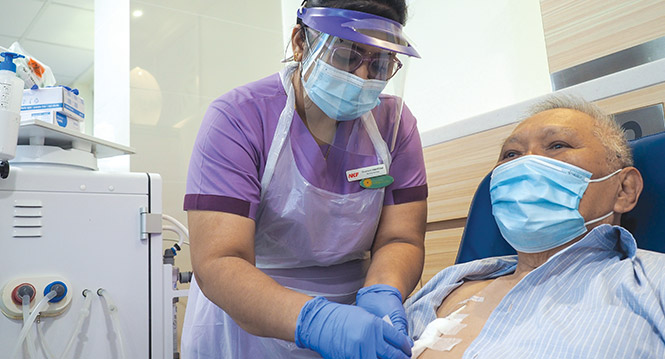
Clot busting procedure done at dialysis centres benefits patients
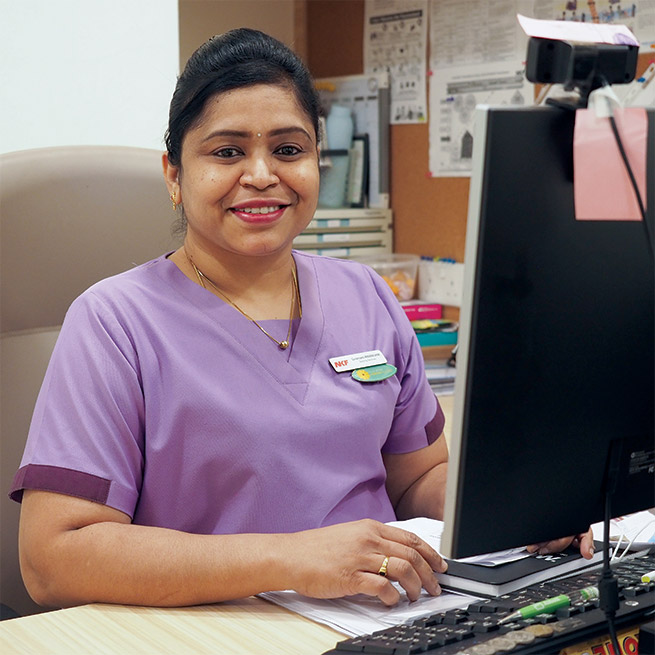
“With the proper training provided to me, I am able to perform the procedure skillfully and confidently. The patients who receive dialysis from NKF will benefit more from this programme and receive better care from us.”
Sivamani Anandam NKF nurse manager who is well trained in the clot busting procedure
Dialysis patient Michael Chan requires the use of a permanent catheter (tunnelled haemodialysis catheter or THC), in which a tube is placed in a large vein in his upper chest, to carry out his haemodialysis treatment thrice weekly at an NKF community-based dialysis centre. This is because he is medically unsuited for the creation of an arterio-venous fistula or the use of a graft, which is required for this dialysis treatment modality. A fistula is an access made by joining an artery and vein in the arm or a surgically created vein, used to remove and return blood during dialysis.
There may be instances when the permanent catheter may get clotted and blocks the free flow of blood. This could be due to the flow rate going below the required level. The patient is then required to undergo a procedure in a hospital-setting, in which a “clot busting” medication is injected directly into the catheter opening.
For 70-year-old Michael, who has been on dialysis since 2019 and wheelchair-bound, he experienced this twice. It meant that he needed to spend time travelling to the hospital, go through the long waiting time at the accident and emergency department, undergo preliminary assessment and tests before the procedure, and even had to stay for two days in the hospital.
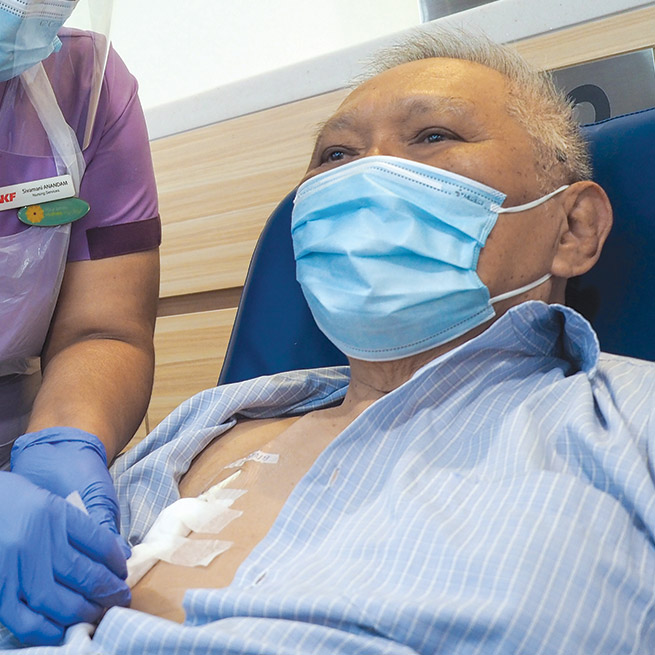
“At the dialysis centre, I felt very comfortable and happy with the nurse doing it. It went well and I could straightaway start dialysis after that.”
Michael, who benefitted from the clot busting procedure carried out conveniently at the dialysis centre
To better facilitate such procedures and minimise dialysis treatment interruptions, a batch of NKF nurses have been trained by a hospital nephrologist to carry out the procedure in our community-based dialysis setting as part of a pilot project in collaboration with the Ministry of Health, National Improvement Unit (NIU) and several Public Health Institutions to unblock malfunctioning THC in December last year. Taking care of the clot early also results in fewer treatment interruptions, thus not compromising on adequacy in dialysis treatment and patients’ quality of life over time.
As such, Michael, who had issues with his permanent catheter early this year, went through the procedure at the dialysis centre. The medication that was injected into him by the nurse remained inside the catheter to break down the clot. Following a dwell time of one hour to monitor his condition, he was able to proceed with his dialysis treatment.
Michael said, “I didn’t have to go through the inconvenience of finding transport to go to the hospital for the procedure, not to mention the many tests, long stay and costs involved. It can be stressful and tiring, for my wife as well, as she has to accompany me and she’s not in the best of health. At the dialysis centre, I felt very comfortable and happy with the nurse doing the procedure. It went well and I could straightaway start dialysis after that.”
Following the success of this ground-breaking initiative, which has turned a one-day hospital admission into a procedure done at the dialysis centre with costs and time savings, it will gradually be implemented across all NKF’s 41 dialysis centres. More NKF nurses will be trained to carry out this procedure with the aim of benefitting over 700 patients using permanent catheters.


